How I Went From My First Dev Job to Building AI Systems
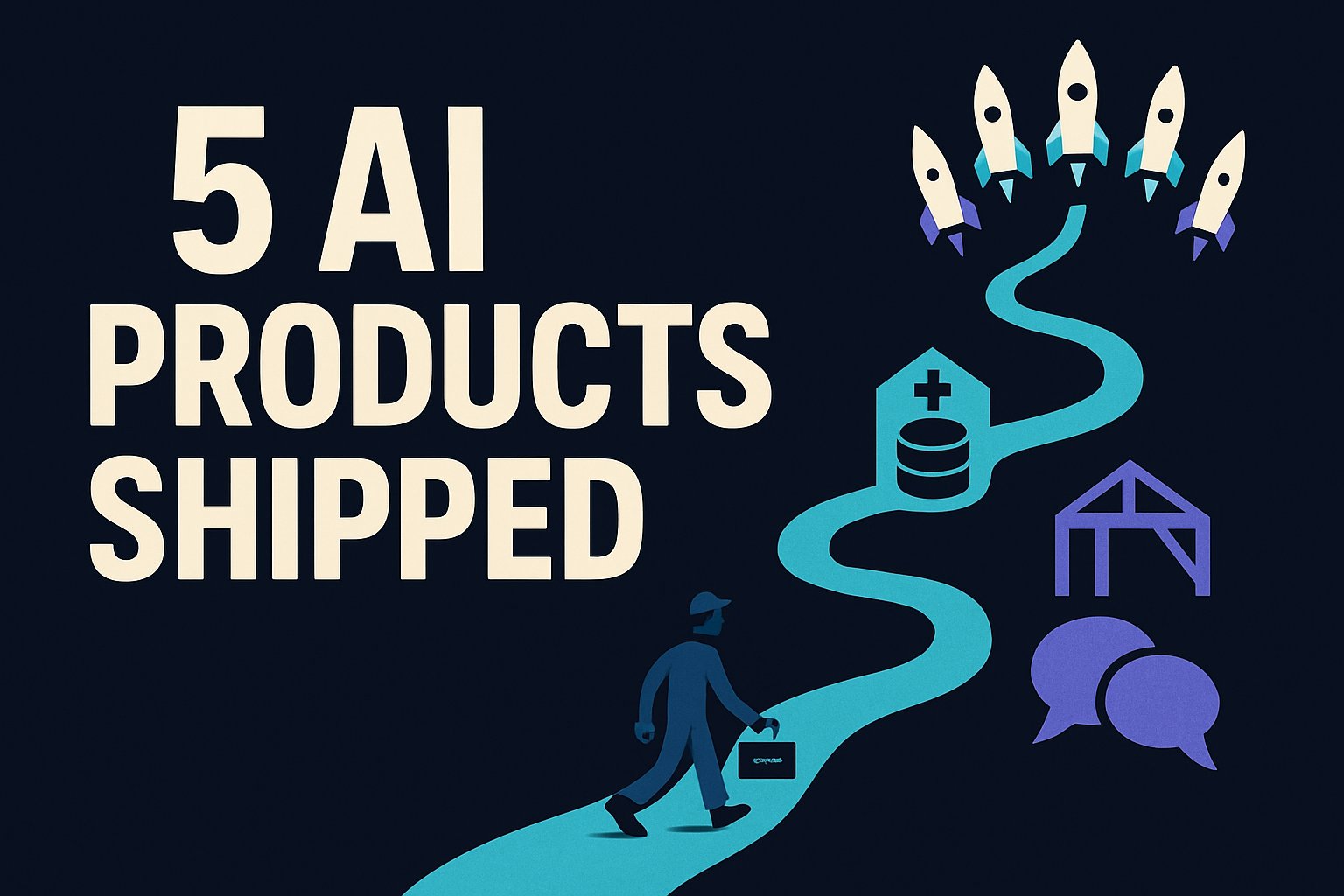
In September 2021 I started my first developer job at Manorama Infosolutions, a healthcare software company. The stack was ASP.NET on the backend and React on the front. Nothing about it was glamorous. Hospital information systems don't trend on Twitter. But real users depended on the software every day, and that changes how you write code before you have the experience to know why.
Those first eighteen months taught me the things that still carry everything I build: how data actually moves through a system, why an API contract matters more than the code behind it, what happens to your architecture when concurrent users show up, and how much of engineering is unglamorous plumbing done carefully. I didn't know it then, but I was learning the substrate that AI systems would later run on.
Going full-stack
In January 2023 I moved to MSA Software as a full-stack web developer and went all-in on the JavaScript side: Node.js APIs, React frontends, MongoDB underneath. The work that shaped me most wasn't building new features. It was making existing systems behave — profiling slow MongoDB aggregation pipelines until legacy latency came down, and moving teams onto TypeScript and Next.js so a whole class of production bugs stopped existing.
That period rewired how I think about the job. The valuable work wasn't typing code; it was deciding where types, boundaries, and indexes should live so the code that got typed couldn't go wrong. I didn't have the phrase for it yet, but that was my shift from developer to architect.
Then ChatGPT dropped
The timing is almost funny: ChatGPT launched a few weeks before I started that full-stack role. Like most engineers, I went through the arc — dismissed it, played with it, depended on it, and then realized the profession was quietly reorganizing underneath me. I decided early on that I'd rather be the engineer who understands how these systems work than the one hoping they don't matter.
So while my day job was MERN, my nights became embeddings, vector search, retrieval pipelines, prompt design, evals. The earliest posts on this blog are literally that homework in public. What I found surprised me: my full-stack background wasn't obsolete in the AI era — it was the prerequisite. A RAG pipeline is an API with a database and a cache. An agent is a state machine with side effects. The people who struggle to ship AI systems usually aren't missing AI knowledge; they're missing the systems fundamentals I'd spent four years absorbing.
Making it official
In June 2025 the two tracks merged: I joined Sparity as a senior software developer working on exactly this — integrating LLMs and agentic workflows into production MERN systems, owning them from architecture through deployment. The night studies became the day job.
And then I started building for myself. Over the following year I shipped five products solo — a realtime telemetry cockpit for streamers, a React Flow workflow engine, a local-first AI finance agent, and two autonomous pipelines that write and distribute content for this site. Each one exists because I wanted to test a conviction about how AI systems should be built: models get leverage, never authority; data contracts before code; infrastructure only when nothing simpler works. This portfolio is the lab notebook.
What I'd tell the 2021 version of me
- The boring fundamentals compound. Every hour spent understanding data flow in a hospital records system is still paying dividends in agent architectures.
- Career shifts don't announce themselves. Mine happened at night, in the gap between what my job needed and what the industry was becoming.
- You don't abandon a stack to work in AI. You stand on it. The model is one component in a system, and someone still has to build the system.
Five years from an ASP.NET healthcare backend to shipping autonomous AI products. The tools changed completely. The job — understanding systems well enough to be trusted with them — never did.
Want this built for your business?
I build what this post describes for clients — RAG chatbots on your own documents, AI added to systems you already run, custom software — at fixed prices you see before we start. Hiring instead? I'm open to senior and lead roles.