I Built an AI Money Agent That's Structurally Incapable of Touching the Money
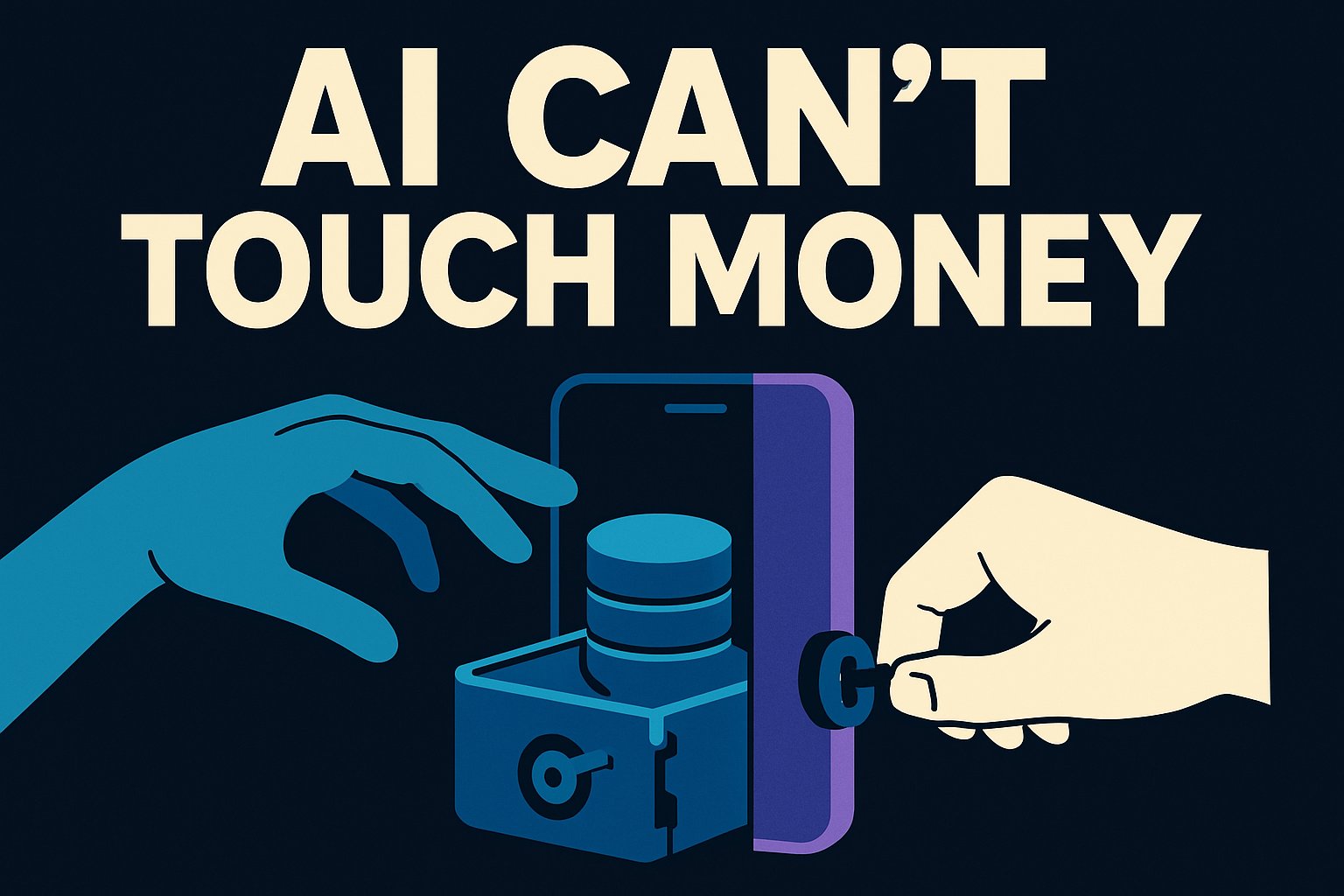
Personal-finance apps ask for the most sensitive data a person owns and then ship it to someone else's cloud. AI finance apps go further: they hand that data to a language model and let probabilistic text decide what happens to real money. I built Sable to reject both premises at the architecture level — a local-first AI financial agent where all data lives on-device in SQLite, and where the model can propose but is structurally incapable of committing.
Trust boundary #1: the data never leaves
Sable is a React Native app with no cloud backend. Every debt, every payment, every balance lives in on-device SQLite — full stop. When the AI layer needs context ("how is my spending pacing this month?"), it queries the local database. What crosses the network to the model is a distilled, minimal context — never the ledger. Most products bolt privacy on as a policy. Sable has it as a topology: there is no server to breach because there is no server.
Trust boundary #2: the model proposes, the human commits
The agent uses OpenAI function calling — but every function call is a dry run. When the model decides "log a ₹5,000 payment against the car loan," that intent renders as a Review & Confirm card in the UI. The model's output is a proposal object; the database mutation only executes when a human taps confirm. An LLM hallucination in Sable can produce, at worst, a card you dismiss. It can never produce a wrong number in your ledger.
The question that should govern every agentic product: what is the blast radius of the model's worst output? In Sable the answer is "one dismissible card" — by architecture, not by prompt engineering.
The unglamorous engineering that makes it real
- Serialized writes: a queue funnels every SQLite mutation through one at a time, eliminating the write-lock contention that plagues on-device databases.
- A daily local RAG job: each morning the agent reads the on-device ledger and delivers a proactive Morning Briefing to the lock screen — spend pacing, upcoming obligations, anomalies — without a single byte of financial data leaving the phone.
- Offline-first by default: the app is fully functional in airplane mode; the AI layer is an enhancement, not a dependency.
Why this pattern matters beyond finance
Every enterprise deploying agents faces Sable's problem in costume: healthcare records, legal documents, internal financials — data that wants AI leverage but cannot tolerate AI authority. The propose/confirm boundary and the local-context pattern transfer directly: give the model read access to distilled context, render its intents as reviewable artifacts, and reserve the commit for a human or a deterministic policy. I built the reference implementation into a product I use every day — the full breakdown is on Sable's product page.