The $0 Content Engine: My Blog Writes, Commits, and Deploys Itself Twice a Week
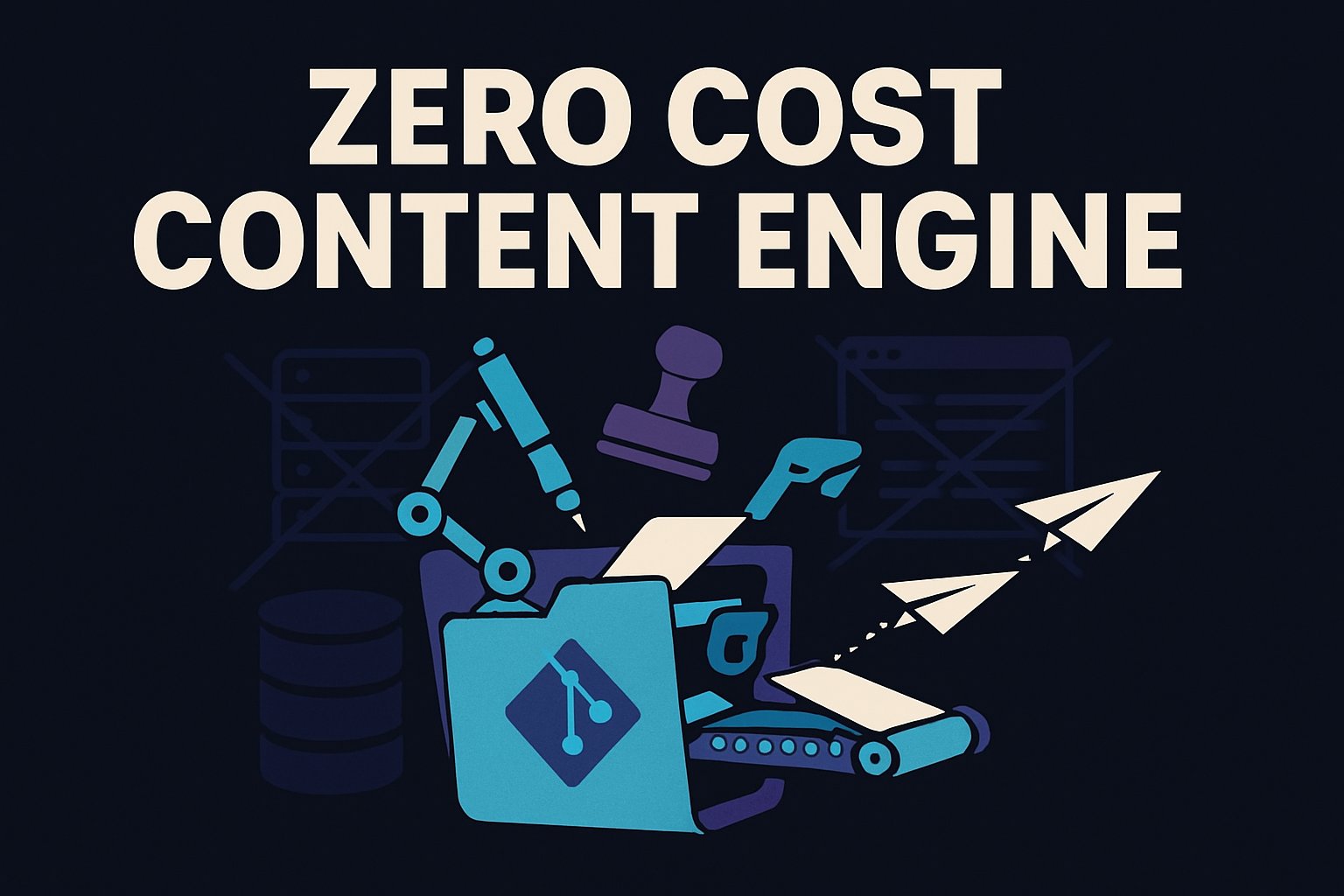
The blog you are reading is partly written by an employee who costs me nothing. Twice a week, on a cron schedule, a pipeline wakes up inside this site's own repository: it pulls the next topic from a plain text queue, drafts a technical article with Gemini, writes it as an MDX file, commits it, and lets the deploy workflow publish the static site. No CMS. No database. No server. The steady-state bill is exactly $0 — and it has never missed a deadline.
The whole stack is a Git repository
The design bet was to refuse infrastructure. The content queue is scripts/topics.txt — one topic per line, consumed top-down, editable with a normal commit. The "database" is the Git history. The "deploy hook" is a push to main. The writer is a small Python script using the google-genai SDK against gemini-2.5-flash, and — crucially — the script, not the model, owns the slug, the date, and the frontmatter, so a malformed response can never corrupt the typed build. Every article is a commit I can diff, revert, or edit by hand.
Discipline is what makes it free
- Static export: Next.js compiles the entire site to plain HTML at build time — GitHub Pages serves it for free, with no runtime to secure or scale.
- Free compute at the edges: GitHub Actions runs both the writer and the deploy inside free-tier minutes, because the jobs are minutes long by design.
- Model as contractor, script as employer: the LLM is invoked for prose only; structure, validation, and publishing remain deterministic code. That boundary is why the pipeline is trustable enough to run unattended.
Everyone building with AI eventually learns the same lesson: the model is the cheap part. What you pay for — in money and in incidents — is the infrastructure you wrap around it. So I wrapped it in nothing.
Why a hiring manager should care
This little system demonstrates the judgment that expensive cloud architectures often lack: knowing when the correct amount of infrastructure is none. The same instinct scales up. Before I reach for a queue service, a serverless fleet, or a vector database with a monthly invoice, I ask what the Git-history version of the solution looks like — and a surprising fraction of the time, it is good enough to ship and cheap enough to forget.
An SEO-ready technical blog that grows itself is a real business asset — content compounds into search traffic, authority, and inbound interest. Mine costs zero and runs on rails I built in days. The full teardown, including the workflow YAML and the writer script, is on the product page.